From missing pool towels to IoT asset intelligence
For most hotels and resorts, the humble towel remains an unmanaged asset and a silent source of cost. Hundreds of pool towels, spa linens, and bath sheets circulate daily between rooms, the pool deck, wellness areas, and the laundry, yet very few properties track these units with the same discipline they apply to room keys or minibar products. A modern towel tracker turns this blind spot into a measurable, optimisable process that operations leaders can monitor in real time.
In a typical resort, pool towels and spa textiles represent one of the highest recurring linen costs per guest night. Without a digital towel management strategy, unreturned towels, unreported damages, and late return of towels by guests accumulate into significant hidden losses. By embedding RFID or Bluetooth tags into each towel unit and connecting them to a central system, IT directors gain real time visibility on every clean towel, every dirty batch, and every return event across the property, including shared services with nearby hospitals or clinics.
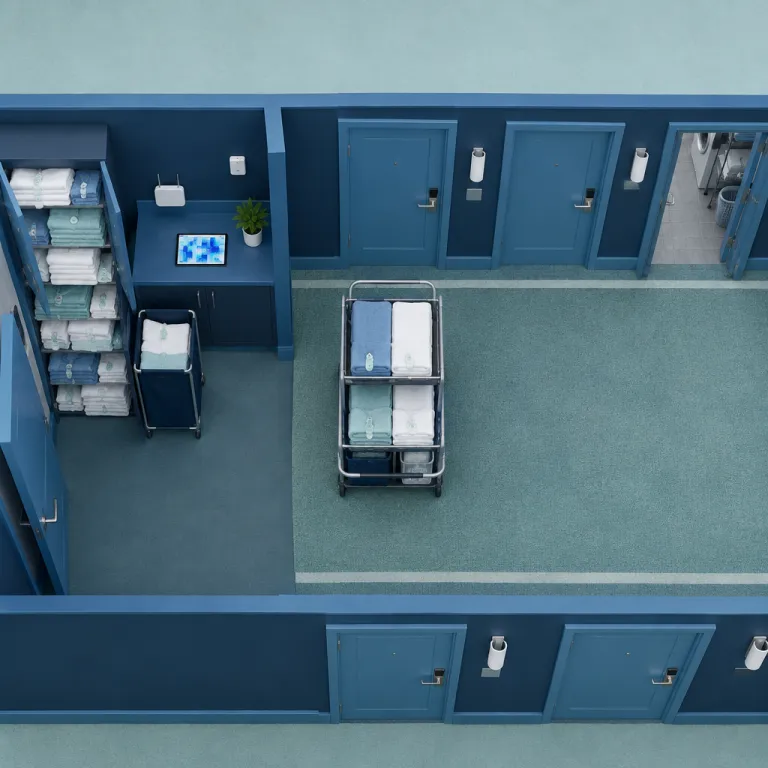
Smart cabinets placed near the pool or in the spa can automate the issue and return of towels guests use throughout the day. Guests swipe their room key or wristband, the cabinet door unlocks, and the software logs which towels are taken and when the system expects guests to return towels. This high tech yet discreet approach aligns with the expectations of digital native guests, while giving management and staff precise data to reduce towel losses, rebalance inventory across outlets, and maintain consistent availability of pool towels and other textile assets.
Architecting a towel tracker system for smart hotels and hospitals
Designing a robust towel tracker architecture starts with a clear mapping of all circulation flows. Towels move between rooms, the pool deck, back of house cabinets, the laundry, and sometimes external partners such as hospitals or medical clinics that share a central laundry. Each movement must be captured by the system through fixed readers, mobile scanners, or intelligent cabinet sensors that can reliably detect clean and dirty items, even in humid or high temperature environments.
At the core sits a towel management platform that consolidates every tracker event into a single source of truth. This software should expose APIs to the PMS, the housekeeping system, and the laundry operator, so that clean dirty status, stock levels, and towel loss indicators are synchronised automatically. When a clean towel leaves a cabinet, the system decrements inventory and starts a virtual timer until the item is scanned as dirty or registered as a return towels event, allowing staff to intervene before shortages occur or losses towel metrics spike.
For multi property groups and urban resorts with shared services, the same architecture can extend to medical scrub and scrubs tracking for spa therapists, wellness staff, or clinical teams. Hospitals that operate integrated hotels or patient family residences already use similar products to manage medical scrub circulation and reduce textile costs, with peer reviewed studies on RFID in healthcare reporting 30% to 50% reductions in linen losses. Lessons from these environments, combined with hospitality specific IoT practices such as smart room entertainment and casting systems described in analyses of how casting systems redefine smart room entertainment, help CTOs design a scalable, secure, and interoperable towel tracker system.
Data, AI and predictive towel management for operations leaders
Once every towel unit is connected, the real value emerges from data and AI. Over a few weeks, the tracker system accumulates granular information on how guests use pool towels, how quickly staff collect dirty items, and how long laundry cycles take from pick up to return. This creates a rich dataset for predictive towel management and cost optimisation that can be shared with finance and operations teams, and benchmarked against hospital and clinic use cases.
Machine learning models can forecast the number of clean towels required per outlet per hour, based on occupancy, weather, events, and historical guest towel behaviour. When the system predicts a spike at the pool deck, it can alert staff to refill the cabinet before guests swipe their cards and face an empty dispenser. The same algorithms can flag abnormal towel losses in specific zones, prompting targeted audits instead of generic policies that frustrate guests and staff and fail to address the root causes of towel losses.
For IT and innovation leaders, the integration of towel tracker analytics with broader hotel data strategies is crucial. Insights from towel losses, laundry turnaround times, and clean dirty ratios should feed the same data lake that powers pricing, marketing, and smart room decisions, as explained in analyses of how to choose the best Chromecast solution for smart rooms. When textile costs, energy consumption in laundry, and guest satisfaction scores are analysed together, executives can quantify the true cost and ROI of every clean towel delivered across the property and compare it with benchmarks from hospitals and other sectors.
Guest experience, privacy and behavioural design around towels
Any towel tracker deployment must respect the delicate balance between operational control and guest freedom. Guests do not want to feel monitored when they pick up pool towels or when they request extra towels in their suite, yet they appreciate reliability and constant availability. The design of the system, from cabinet interfaces to signage, should emphasise convenience rather than surveillance and make the technology feel like a natural part of the pool experience and wider resort journey.
On the pool deck, smart cabinets can be branded as self service towel stations where guests swipe their room key once and then access multiple towels guests may need for family use. Clear messaging explains that the system helps ensure a clean towel is always available, while also reducing unnecessary laundry and environmental impact. When guests understand that better towel management reduces water and energy consumption, they are more likely to comply with gentle nudges to return towels promptly and keep the pool area tidy, which in turn lowers losses towel metrics and improves sustainability reporting.
Privacy by design is non negotiable for IT directors and investors evaluating high tech textile products. The tracker system should store only the minimum data required to link a towel unit to a room account for potential charges, and retention periods must be clearly defined and audited. Behavioural analytics can still operate on aggregated data, allowing management and staff to optimise processes without exposing individual guest patterns beyond what is necessary for fair billing and loss prevention, in line with data protection regulations.
Financial impact, cost models and cross sector benchmarks
For CFOs and CTOs, the business case for a towel tracker hinges on measurable reductions in costs and losses. Baseline studies in resorts often show double digit percentages of towel losses per season, especially for pool towels and spa linens that never return from the pool deck or beach. When each towel unit costs several euros to purchase and wash across its lifecycle, these leakages quickly outweigh the investment in IoT tags and software, as confirmed by audits from major textile service providers such as Elis and Berendsen and by independent hospitality consulting reports.
Hospitals and large clinics provide a useful benchmark, as they have long used tracker systems for scrubs, medical scrub items, and high value textiles. Their experience shows that digital cabinet dispensing and automated return tracking can reduce textile losses by more than half, while also cutting labour costs linked to manual counting and reconciliation. Hotels that adopt similar products for towel management often report lower costs per occupied room, because clean dirty cycles become shorter, and laundry loads are sized more accurately based on real time data. A typical implementation might involve tag prices in the low euro range per unit, cabinet hardware in the mid four to low five figure range depending on capacity, and integration projects measured in weeks rather than months.
Different commercial models exist, from capital expenditure on hardware and perpetual software licences to subscription based pricing per tracked unit. Investors should scrutinise not only the direct costs of tags, readers, and cabinets, but also integration costs with existing systems and the impact on staff workflows. When evaluating vendors, it is essential to compare not just headline costs, but also the quality of analytics, the robustness of the system in humid pool environments, and the vendor’s roadmap for AI features that will keep the tech towel platform competitive over time. A simple ROI model over one to three years, combining reduced towel purchases, lower laundry costs, and saved staff hours, helps decision makers validate feasibility before rollout.
Integrating towel trackers into the broader smart hotel ecosystem
A towel tracker should never be an isolated tool; it belongs inside a coherent IoT and data architecture. For IT directors orchestrating smart hotel programmes, the same principles that govern door locks, sensors, and casting solutions must apply to textile tracking. Open APIs, secure authentication, and standard data models are essential to avoid yet another siloed system and to ensure that towel data can be reused across departments, from housekeeping to finance and marketing.
When towel management data flows into the central data platform, marketing and operations teams can align their strategies. For example, a resort that sees high towel losses among day visitors might adjust its pricing, deposit policies, or loyalty benefits, while also refining communication in digital channels as recommended in analyses of hotel marketing for AI driven search. At the same time, housekeeping can use real time dashboards to allocate staff more efficiently between guest floors, the pool deck, and back of house laundry zones, and IT can enforce consistent security policies across all connected products.
Vendors that position themselves as high tech partners rather than simple product suppliers will win the trust of hotels and investors. Their platforms should support not only towels but also other reusable items such as bathrobes, spa garments, and even certain minibar assets, extending the ROI of the underlying tracker infrastructure. For innovation leaders, the strategic question is no longer whether to track towels, but how to embed textile intelligence into a long term vision of connected, efficient, and guest centric hospitality, supported by clear vendor checklists covering hardware durability, software APIs, maintenance services, and AI driven analytics.
Key statistics on towel tracking, laundry and textile losses
- Studies from textile service providers in Europe report that hotels can lose between 10% and 20% of their towels annually through theft, misplacement, or untracked disposal, which significantly increases replacement costs over the lifecycle of each unit; figures published by Elis and Berendsen in industry white papers are frequently cited as benchmarks.
- Industry data from commercial laundries indicate that optimised sorting and scheduling, supported by digital tracking, can reduce water and energy consumption per kilogram of laundry by up to 15%, directly lowering operational costs and environmental impact when combined with efficient towel management practices.
- Hospitals that implemented RFID based systems for scrubs and linens have documented reductions in textile losses of 30% to 50%, providing a strong benchmark for hospitality operators considering similar towel tracker deployments and demonstrating that clean dirty visibility has a measurable financial impact.
- Operational audits in large resorts show that automating towel issue and return through smart cabinets can cut staff time spent on manual counting and reconciliation by 25% to 40%, freeing teams to focus on higher value guest interactions and service recovery instead of repetitive stock checks.
- Guest satisfaction surveys conducted by major hotel groups reveal that reliable availability of clean towels at pools and spas is consistently ranked among the top five service expectations, underlining the strategic importance of robust towel management systems and well designed guests towels journeys.
FAQ about towel trackers and smart textile management
How does a towel tracker work in a hotel environment?
A towel tracker typically uses RFID or Bluetooth tags sewn into each towel, combined with fixed readers, handheld scanners, or smart cabinets placed at key points such as the pool deck, spa, and laundry. When a clean towel is issued or a dirty towel is returned, the system records the event and updates inventory in real time. This allows management and staff to know exactly how many towels are in circulation, where they are located, and which items may be lost or overdue, supporting both operational control and better guest service.
Can guests be charged automatically for unreturned towels?
Yes, many systems allow hotels to link towel issue events to a room account when guests swipe their key card or wristband at a cabinet. If towels are not returned within a defined period, the PMS can apply a charge according to the hotel’s policy, after appropriate communication with the guest. IT directors must ensure that these processes comply with local regulations and that guests are clearly informed about any potential charges at the point of issue, for example through on screen messages or discreet signage.
What is the typical ROI of a towel management system?
The ROI depends on the property’s size, existing towel losses, and laundry costs, but many hotels recover their investment within one to three years. Savings come from reduced towel losses, lower textile purchases, optimised laundry loads, and decreased labour time spent on manual counting. Additional benefits include better guest satisfaction due to consistent availability of clean towels at pools and spas, and more accurate forecasting of linen needs across seasons.
How does towel tracking integrate with existing hotel software?
Modern towel tracker platforms usually provide APIs that connect to the PMS, housekeeping software, and sometimes the building management system. This integration allows towel status, inventory levels, and potential charges to flow automatically between systems, reducing manual data entry and errors. When evaluating vendors, CTOs should prioritise open architectures, documented integrations with their current technology stack, and clear support models for ongoing maintenance and updates.
Is towel tracking technology suitable for smaller boutique hotels?
Smaller properties can also benefit from towel management solutions, especially if they operate high usage areas such as rooftop pools or popular spas. While they may not need large smart cabinets, handheld scanners and a lightweight software platform can still provide visibility on clean dirty cycles and reduce losses. Scalable pricing models and modular hardware make it possible to start with a limited deployment and expand as the business case is proven, with some vendors offering entry level packages tailored to boutique hotels.
