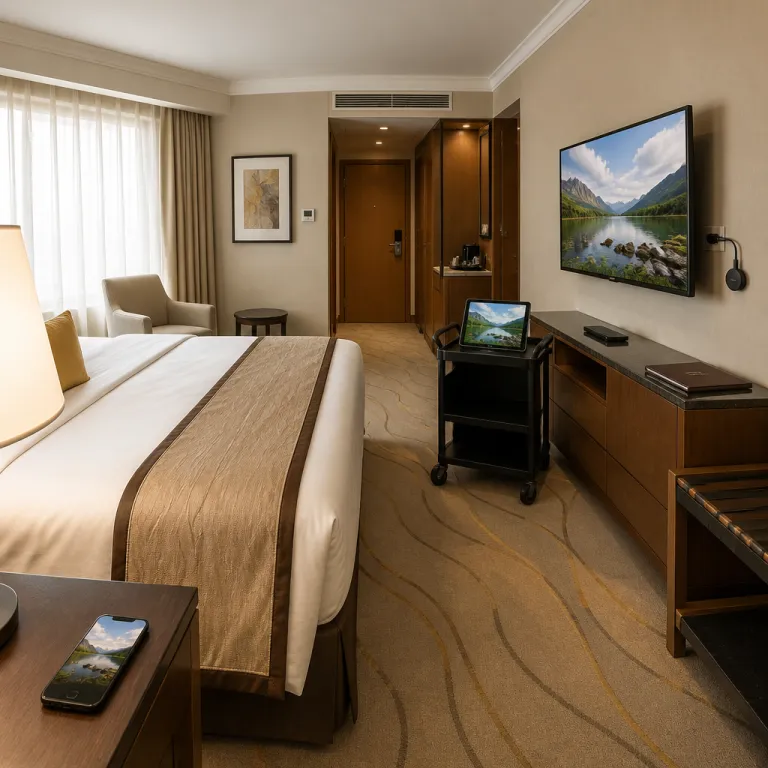
From cable fatigue to intelligent tv casting for hotels
Hotel IT leaders recognise that traditional linear channels and legacy set-top boxes no longer match how guests consume content. Many travellers now arrive with a personal device full of streaming apps and expect to project or cast their own content to the in-room television. This shift makes tv casting for hotels a strategic pillar of the modern digital guest experience rather than a nice-to-have amenity.
Across hospitality brands, device casting is rapidly replacing legacy video-on-demand systems that were costly to maintain, slow to update, and limited in choice. When guests mirror or cast their own entertainment, they bring preferred streaming services, language settings, and accessibility features directly into the room. This creates a more intimate, personalised experience while reducing the need for hotels to negotiate complex content licensing deals or manage large catalogues.
Industry data already shows that properties offering a robust in-room casting solution see a measurable uplift in satisfaction scores. For example, the 2022 Hotel Internet Services “Guestroom Entertainment” survey reported that 67% of guests consider the ability to stream content from personal devices important to their stay, and properties that upgraded in-room entertainment to support secure casting saw notable gains in guest satisfaction and review scores. As one regional IT director for a European upscale chain put it, “Once we enabled secure streaming from guests’ phones, entertainment complaints dropped almost overnight.” For IT directors and CTOs, this is not just about entertainment; it is about aligning the in-room technology stack with how guests stream content at home.
Architecting secure tv casting for hotels at scale
Behind the apparent simplicity of guests casting from a personal device lies a complex network architecture. A secure implementation of tv casting for hotels must isolate each room on the Wi-Fi network so that no guest can see another room television or any other devices. This is where hospitality-specific casting solutions such as INTELITY, OnlyCast, and TouchTown have focused their innovation and product design.
These providers integrate Google Chromecast or Chromecast with Google TV devices into the hotel infrastructure while enforcing strict security policies. Their casting platforms typically use virtual local area networks and per-room authentication tokens so that streaming works only between a guest device and the correct screen. For IT directors, this approach avoids the need for additional logins on the television itself, which reduces friction, shortens setup time, and cuts support tickets.
Specialist vendors also provide management consoles that allow hotels to monitor devices, push firmware updates, and support casting remotely without entering the room. A 2023 Hotel Internet Services follow-up report on guestroom technology noted that properties using centrally managed casting hardware reduced on-site troubleshooting visits by double-digit percentages. For a deeper technical view of how Chromecast casting is transforming in-room strategies, many technology teams now benchmark their roadmap against specialised analyses of Chromecast solutions for hospitality and vendor whitepapers on network segmentation. This level of control is essential when hundreds of rooms, thousands of hotel guests, and multiple streaming services must coexist on the same network.
Designing a frictionless casting journey for every guest
Even the most elegant casting infrastructure fails if guests cannot understand how it works within seconds. The ideal tv casting for hotels flow starts when the guest enters the room and immediately sees a clear on-screen message explaining how to cast content directly from a phone, tablet, or laptop. A simple QR code that pairs the personal device with the room television often removes the need to search for devices or navigate complex menus, which is especially valuable for short-stay or late-arrival guests.
Once connected, guests stream content from their usual streaming services without entering passwords on the television or dealing with additional logins. This is where hotel casting truly differentiates itself from built-in smart TV apps, because guests cast from apps they already trust on their own devices. When travellers stream their favourite series, sports events, or music playlists, they perceive the room as an extension of their home entertainment ecosystem rather than a generic hotel space.
To reinforce trust, the system must clearly show that all guest casting sessions end automatically at checkout or when they disconnect from the network. Clear messaging that no content is stored and that no credentials remain on the device in the room is critical for privacy-sensitive travellers. For IT and innovation leaders, this user journey becomes a core part of the overall guest experience design, just as important as mobile check-in or digital keys, and is increasingly evaluated alongside analyses such as why Chromecast-powered casting is becoming the new standard for in-room entertainment.
Integrating tv casting for hotels into the wider smart room stack
In many hotels, tv casting for hotels is now deployed alongside IoT sensors, smart thermostats, and voice assistants to create a coherent smart room. The room television becomes a central screen that can show entertainment, hotel information, and contextual messages triggered by other devices. When a guest adjusts lighting or temperature via a mobile app, the same interface can also present shortcuts to guest casting features or highlight available streaming options.
Forward-looking hospitality brands are connecting casting solutions to their Property Management System and Customer Relationship Management platforms. This allows them to understand which entertainment options hotel guests prefer, which streaming services are most used, and how often guests cast from different types of personal device. With proper anonymisation, these data points help refine investment decisions on bandwidth, screen size, and future entertainment options, while avoiding intrusive personal profiling.
Artificial intelligence adds another layer by predicting when guests are most likely to stream content directly after check-in or late at night. This can inform dynamic network management, ensuring that Wi-Fi capacity is available when guests stream high-definition video to each room. For a broader view of how AI orchestrates these experiences across the property, many IT teams now study best practices in hospitality virtual assistant services and AI operations in hotels, using them as reference points when planning next-generation smart room programmes.
Operational realities : deployment, support, and ROI
Rolling out tv casting for hotels across a multi-property portfolio requires rigorous planning and cross-functional coordination. IT teams must audit existing network capacity, evaluate where Chromecast or equivalent devices will be installed, and define how support casting will be handled by on-site staff. A pilot phase in a limited number of rooms often reveals practical issues such as remote control labelling, on-screen instructions, and the impact on call centre volumes.
From a financial perspective, casting solutions usually offer a more attractive ROI than traditional pay-per-view systems. Hotels no longer need to manage large catalogues of licensed content, yet they still provide rich entertainment options because guests cast their own streaming services. Capital expenditure shifts toward robust Wi-Fi, reliable room television hardware, and centrally managed casting devices that can be monitored at scale, with clear lifecycle plans for replacements and upgrades.
Operationally, the most successful hotels treat guest casting as a core service, not a gadget. They train front desk and maintenance teams to explain how guests cast from their apps, troubleshoot basic issues, and escalate complex network problems to specialised support. In one midscale European property, for example, staff training and clearer in-room instructions cut entertainment-related support calls by nearly a third within three months of deployment, according to an internal post-implementation review shared at a regional IT forum. Over time, data on how often guests stream content directly to the screen helps refine staffing, bandwidth planning, and future upgrades of the casting solution.
Security, privacy, and compliance in hotel casting ecosystems
Security concerns remain a decisive factor for CIOs evaluating tv casting for hotels. A poorly segmented network or misconfigured Chromecast casting setup can expose devices across rooms, undermining guest trust and regulatory compliance. To avoid this, hospitality technology teams implement per-room network isolation, encrypted communication between devices, and automatic wiping of any session data when the guest checks out.
Reputable casting solutions such as INTELITY, OnlyCast, and TouchTown design their platforms so that guests cast without ever sharing credentials with the hotel. The television acts only as a receiver, while the personal device maintains the authenticated session with Google, Netflix, or other streaming services. This architecture ensures that no passwords are stored on the room television and that no staff member can access private content directly or indirectly, supporting both brand standards and data protection regulations.
Clear communication is essential, because many hotel guests still ask whether it is safe to stream content in a hotel environment. Providers address this with transparent FAQs such as: “Is it safe to cast personal content in hotels? Yes, reputable systems ensure secure, isolated connections.” When IT leaders combine such assurances with regular penetration testing, configuration audits, and strict vendor governance, guests stream with confidence and the hotel strengthens its reputation for digital trust.
Key statistics on tv casting for hotels
- Industry reports indicate that a growing majority of hotels now offer some form of casting services in their rooms, showing how quickly tv casting for hotels has moved from pilot projects to a mainstream expectation. For instance, the 2023 Hotel Internet Services “Guestroom Entertainment” study found that more than 70% of surveyed guests prefer streaming over traditional channels, pushing properties to accelerate adoption.
- Hotel surveys also show that guest satisfaction can increase significantly when a reliable casting solution is available, underlining the direct impact of guest casting on Net Promoter Score and online reviews. While exact percentages vary by brand and region, several chains have publicly linked double-digit improvements in entertainment satisfaction to the rollout of secure casting platforms and upgraded Wi-Fi.
- Adoption curves suggest that casting solutions began gaining traction in the early part of this decade, accelerated sharply a few years later, and are on track to become a standard feature across most midscale and upscale hotels globally as part of broader digital transformation programmes.
- Properties that invest in robust Wi-Fi and managed casting devices often report a reduction in complaints related to in-room entertainment, as hotel guests stream content directly from familiar apps instead of relying on limited channel line-ups or outdated pay-per-view libraries.
FAQ : tv casting for hotels
How do guests cast to a hotel TV in practice ?
In most implementations, the guest connects to the secure hotel Wi-Fi, opens a casting-enabled app on a personal device, and selects the room television from the list of available screens. Some hotels simplify this by showing a QR code on the television that pairs the device and the room automatically. Once connected, guests stream content directly from their usual apps without entering credentials on the television.
Is it safe for hotel guests to stream personal content ?
When tv casting for hotels is deployed with proper network isolation and vendor best practices, it is considered safe for guests. Reputable systems ensure that each room is on a separate virtual network and that no devices are visible across rooms. As one standard answer explains: “Is it safe to cast personal content in hotels? Yes, reputable systems ensure secure, isolated connections.”
Do all hotels provide tv casting capabilities today ?
Not every hotel has implemented a casting solution yet, although adoption is growing quickly across regions and segments. Larger brands and technology-focused properties were early adopters, while some independent hotels are still evaluating investment priorities. Guests should check pre-arrival information or contact the property directly to confirm whether hotel casting is available in their room category.
What happens to my accounts when I leave the room ?
With modern casting solutions, your accounts remain on your personal device and are never stored on the room television. When you check out or disconnect from the hotel network, the casting session ends and the television returns to its default state. This design avoids the risk of leaving streaming services logged in for the next guest.
Which devices and apps usually support casting in hotels ?
Most tv casting for hotels platforms support recent Android and iOS smartphones, many tablets, and laptops running Chrome or other casting-compatible browsers. Popular streaming services such as Netflix, YouTube, and many regional platforms typically work as long as they support Google Cast on the personal device. Hotels often publish a list of supported apps and devices so that guests can verify compatibility before arrival.
